4 s of calling song, Modoc County, Cal., 23.5°C. Dominant frequency 3.5 kHz.
This sound spectrogram is a 1 s excerpt of the 4 s audio file accessible above.
Song:
A continuous trilling song with a rate of 41 pulses per second at 24.8°C.
Identification:
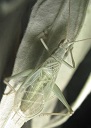
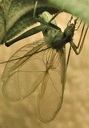
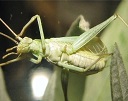
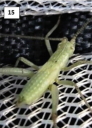
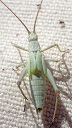
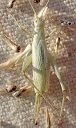
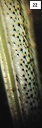
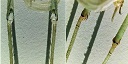
Pasty, milky-green color, narrow tegmina, black antennal markings.
Specimen data:
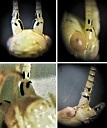
Holotype male, alcohol vial, from Lake Annie, Modoc County, California, USA. Deposited at California Academy of Sciences (CAS).
Range:
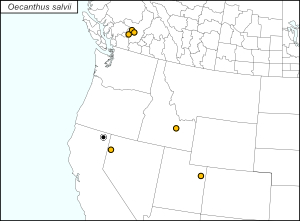
Originally only known from Lake Annie in Modoc County, California. In 2025 new records from iNaturalist expanded this species' range to include Idaho, Nevada, Utah, and British Columbia.
Habitat:
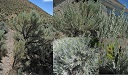
Landscape dotted with sagebrush (Artemisia spp.) and rabbitbrush (Ericameria spp.) shrubs; often bare ground with fine, light greyish brown soil. Host plants include: big sagebrush (Artemisia tridentata ssp. tridenta), mountain sagebrush (Artemisia triden-tata ssp. vaseyana), and rubber rabbitbrush (Ericameria nauseosa) .
Remarks:
The investigation of this new species was prompted by photographs that were posted on BugGuide by Ken Schneider.
The specific epithet was named for Lodovico Salvi who published an article in 1750 with illustrations of tree crickets, 13 years before the first tree cricket was officially described. The common name was given because these tree crickets have a similar color to their sagebrush host plants.